
The key mindset shifts and practical actions that will help you succeed in your new leadership role
“You don’t become a leader the day you receive a new title. You become one the day you realize your success now depends on the success of others.”
The Invisible (and Often Underestimated) Transition
Moving from a technical specialist to a management position is one of the most challenging transitions in a professional career.
Why?
Because it forces you to question the very thing that has always made you valuable.
Until now, your expertise was your greatest strength. People respected you for your knowledge, your results, and your ability to get things done.
But overnight, what made you successful yesterday is no longer what will make you successful tomorrow.
Your impact is no longer measured by what you accomplish.
It is measured by what your team accomplishes because of you.
And that’s where the real challenge begins.
1. Watch Out for Your Professional Ego
Stepping into leadership requires letting go of something:
The immediate satisfaction that comes from being the technical expert.
As a specialist, doing great work brings instant gratification.
As a manager, the outcome is no longer entirely in your hands.
You must learn to let others do the work—even when they don’t do it exactly the way you would.
Practical advice
Resist the temptation to correct, redo, or micromanage.
Technical perfection is no longer your mission.
Developing people is.
Ask yourself every week:
“Am I teaching… or am I replacing?”
2. Beware of the “Super Employee” Trap
Many new managers continue behaving like specialists…
They simply attend more meetings.
They get involved in every detail.
Answer every question.
Make every decision.
The result?
They burn themselves out.
Slow down their team’s autonomy.
And become the bottleneck of the entire system.
What to put in place quickly
- Clarify your priorities. Your role is no longer to execute, but to support, coordinate, and anticipate.
- Delegate progressively—not all at once, but strategically. Choose responsibilities that help your employees grow.
- Set boundaries. Sometimes, saying “no” is the greatest service you can provide to your team.
A great manager doesn’t do everything.
A great manager creates the conditions for everything to be done well.
3. Prepare for the Loneliness of Leadership
The moment you move into management, relationships change.
Yesterday’s peers become today’s direct reports.
And some people will never look at you the same way again.
It’s a delicate transition.
One that often happens silently.
As a new manager, you suddenly find yourself caught between two worlds:
- Leadership, with its expectations and business objectives.
- Your team, with its frustrations, concerns, and daily realities.
What to put in place quickly
- Establish your new leadership identity. You are no longer everyone’s friend, but you can still be approachable and human.
- Communicate your new role. Explain what has changed—and what hasn’t—in the way you work with your team.
- Find a mentor. Learn from someone who has already gone through this transition.
Remember:
Leadership doesn’t come from your title.
It comes from the consistency between your words and your actions.
4. Your Team Becomes Your Leadership Mirror
Every word…
Every action…
Every silence…
Now carries weight.
Your employees are watching you.
They learn from what you do.
They also learn from what you choose not to do.
Most importantly, they pay close attention to how you react under pressure, during mistakes, and when unexpected situations arise.
What to put in place quickly
- Practice self-reflection. Set aside ten minutes every week to evaluate your own leadership.
- Show your humanity. Admit your mistakes. The courage to own them creates a culture of trust and accountability.
- Be consistent. Nothing erodes trust faster than an unpredictable leader.
5. Don’t Lead Without Clarity
Many new managers lead without a compass.
They rely on instinct because no one ever taught them how to lead.
Yet healthy teams are built on three simple foundations:
✅ Clear expectations so everyone understands what success looks like.
✅ Regular feedback to recognize successes and address opportunities for improvement.
✅ Consistent follow-up to ensure the team continues moving forward together.
What to put in place quickly
- Hold regular one-on-one meetings (15 to 30 minutes) to listen, support, and coach your employees.
- Clarify team objectives and success indicators.
- Celebrate progress—not just final results.
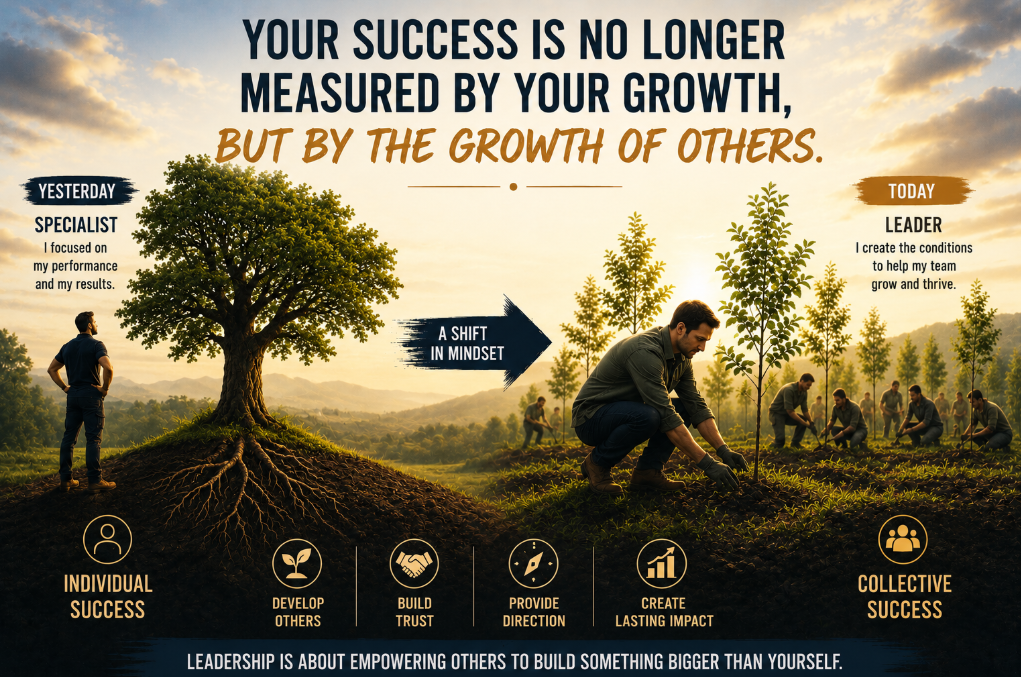
In Summary: Building Your New Leadership Foundation
Leave These Behind
- The need to be the expert
- Individual recognition
- Total control
- Constant reaction
- Short-term thinking
Build These Instead
- The ability to elevate others
- Collective success
- Shared trust
- Proactive leadership
- Sustainable growth
Leadership Is Not a Promotion. It’s a Transformation.
You don’t need to become someone else.
You simply need to expand your sphere of influence.
The qualities that made you an outstanding technical specialist—discipline, curiosity, and a commitment to excellence—remain incredibly valuable.
But succeeding as a manager requires adding three new leadership skills:
- Patience — because developing people takes time.
- Trust — in both yourself and those around you.
- Clarity — because people perform better when they understand the purpose behind their work.
What About You?
What was the most difficult part of your transition into management?
What do you wish someone had told you on your very first day as a leader?
Share your lessons, your doubts, or your advice to help technical specialists who are about to take this important step.
Carl-Michael Tessier, M.Sc., MBA
Coach for High-Performance Team Development and Customized Leadership Support


