
One of My Greatest Strengths Is Also One of My Biggest Weaknesses: I Trust People
One of my greatest strengths is also one of my biggest weaknesses: I trust people.
Generally speaking, that is a strength. Because in life, most people around us genuinely want to see us succeed and be happy. But as you move up the organizational ladder, the game changes. Internal politics, competition for promotions, and the need to protect one’s position begin to play a role. In that environment, trust can quickly become vulnerability.
That is exactly what happened to me.
Among the mistakes I made as a warehouse manager, this one stands out: I handed my manager all the ammunition he needed to prove I was incapable of running the department. And he did not hesitate to use it.
The Context
A few weeks before my annual performance review, my manager asked me to complete a self-assessment covering my first six months in the role.
The request was simple:
- Share my accomplishments and what I was proud of.
- Identify the areas where I wanted to improve.
Nothing unusual so far.
So I prepared a long list.
On one side, my successes and the achievements of my team.
On the other, an even longer list of challenges, difficulties, and areas where I felt I could improve.
To me, that was completely normal. I believed that a good leader should demonstrate self-awareness. Identifying opportunities for growth is the foundation of professional development.
If one of my employees had brought me such a list, I would have congratulated them. Together, we would have built an action plan to help them improve.
But I had forgotten one critical thing: I was not sitting in an employee’s chair.
I was sitting on an ejection seat.
What I Had Forgotten
I had forgotten that my manager had already terminated two managers in the previous eighteen months.
I had forgotten that my team was hostile and difficult to manage.
I had forgotten that I was still in a vulnerable position, being closely watched by senior leadership.
And most importantly, I had forgotten to protect myself.
Why?
Because I trusted him.
Before he became my manager, he was my friend. We had spent time together outside of work. A sense of friendship and trust had developed. I believed that relationship protected me and allowed me to be completely transparent.
The Performance Review
During the formal review meeting, my manager seemed pleased. He thanked me for my honesty and transparency. We discussed actions to address my weaknesses and improve my performance.
Even better, I received a salary increase that was above average.
I left the meeting convinced that everything was going well.
But appearances can be deceiving.
A few weeks later, when pressure in the department increased and senior leadership demanded results, my manager needed someone to blame.
And guess what he used to protect himself?
My own list.
My own words.
The very things I had shared honestly and vulnerably were turned against me.
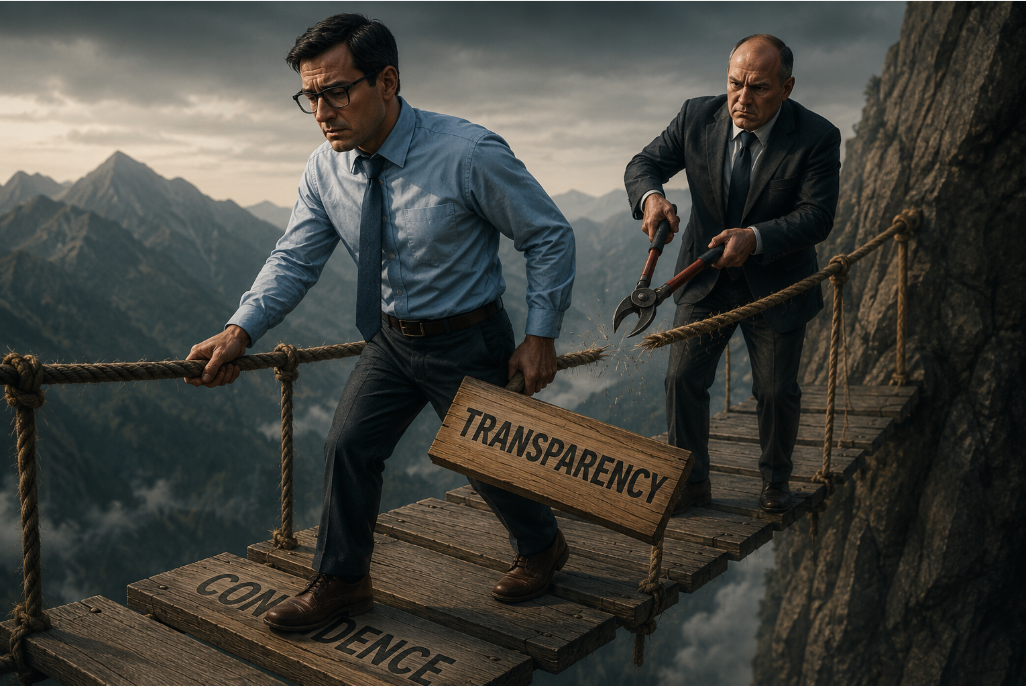
The Fall
That transparency cost me my job.
What I believed was a sign of maturity and accountability became evidence of incompetence.
Not because it was true.
But because, under pressure, my manager needed to shift the blame.
And he did so using the ammunition I had handed him myself.
What Did I Learn?
Did this experience make me bitter?
No.
Did it destroy my ability to trust people?
Not at all.
But it taught me something important:
Complete transparency is not always the right strategy.
This is not an invitation to lie.
It is a reminder that we must choose our battles and our moments carefully.
Being honest does not mean exposing yourself without protection.
Being vulnerable does not mean handing weapons to people who may one day use them against you.
In the corporate world, there are allies.
But there are also sharks.
And it would be naïve to believe that everyone places your well-being at the center of their priorities.
Key Lessons
Here is what this experience taught me:
1️⃣ Always evaluate the context before opening up.
Transparency is a strength, but it must be adapted to the actual level of trust and the political climate.
2️⃣ Do not confuse friendship with a reporting relationship.
A manager is still a manager.
Even if they are friendly and supportive, they will ultimately be judged on results. When pressure rises, they may prioritize protecting themselves.
3️⃣ Highlight strengths before weaknesses.
Yes, you should discuss areas for improvement.
But always begin by demonstrating your accomplishments. They establish credibility before you address your challenges.
4️⃣ Pair every weakness with a solution.
Identifying a problem without proposing a path forward can make it appear that you are overwhelmed by the situation.
Connecting each challenge with a concrete action plan demonstrates ownership and control.
5️⃣ Seek feedback regularly.
Do not wait for the annual review.
Ask your leaders regularly how satisfied they are with your performance. This allows you to make adjustments before problems become critical.
6️⃣ Learn how to protect yourself.
Be open.
But be discerning.
Some conversations are best shared privately with a trusted mentor rather than documented in an official report that may resurface at the worst possible time.
Conclusion
This experience was costly.
It cost me an important position and forced me through a painful period of self-reflection.
But it also gave me a valuable lesson:
Trust is a strength.
Naivety is a risk.
Today, I still trust people.
But I am more thoughtful about when, how, and to what extent I open up.
I have learned that managers must do more than develop technical expertise and people skills.
They must also learn how to navigate organizational politics.
So if you are a manager, remember this:
Transparency is a strength, but it must be accompanied by strategy.
Trust is essential, but it must be balanced with prudence.
And above all, never hand someone all the ammunition they may one day have an incentive to use against you.
Because in business, it is not enough to perform well.
You must also learn how to protect yourself.
Carl-Michael Tessier, M.Sc., MBA
Coach and Consultant in Leadership Development and High-Performance Teams


