
We often hear that growth requires stepping outside our comfort zone.
But when the pressure builds and the storm hits, we naturally fall back on what feels familiar.
That’s exactly what happened to me.
Among the series of mistakes that eventually led to losing my position as a warehouse manager, one stands above the rest:
I slipped back into my old habits as a supervisor, even though my new role demanded something completely different.
The Trap of Wanting to Do Everything
My department employed approximately sixty people across five shifts, operating 24 hours a day, seven days a week, in two separate warehouses.
It was nearly impossible for one supervisor to support that operation alone.
Naturally, I wanted to help.
Helping wasn’t the mistake.
Doing his job for him was.
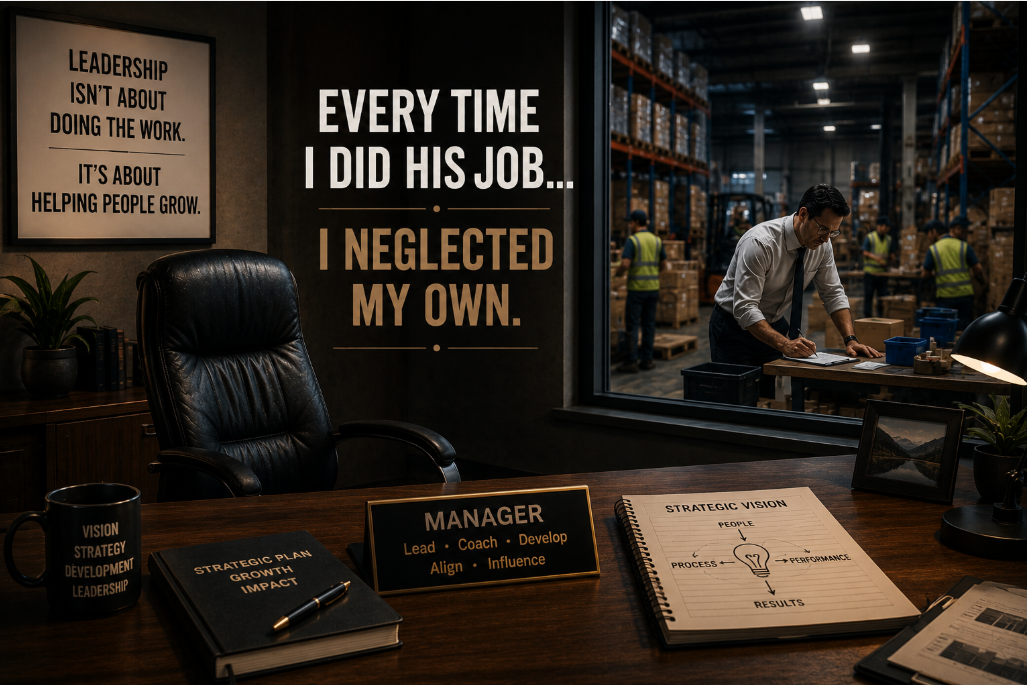
I hadn’t yet realized that my role as a senior manager was no longer to do the work.
It was to ensure the work got done.
To coach.
To build structure.
To develop people.
Instead, I kept jumping back into the day-to-day operations.
Ironically, while I was pulling my supervisor out of the water, he was quietly undermining my credibility with both employees and senior leadership.
Not exactly a winning combination.
If you’ve read my previous article, you already know who I’m talking about.
Here are a few examples of how I gradually took back responsibilities that no longer belonged to me.
1️⃣ Weekly Team Meetings
Every week, we gathered employees to discuss safety, improvement projects, operational issues, and day-to-day concerns.
I facilitated every meeting.
Which meant I absorbed all the pressure…
The frustrations…
The criticism…
Usually in front of the entire team.
In an already tense environment, those meetings could quickly become explosive.
Looking back, some discussions absolutely belonged to me—strategy, long-term vision, continuous improvement initiatives.
But conversations about daily operations and routine floor issues should have been led by my supervisor.
By taking over his responsibilities, I allowed him to avoid difficult conversations…
And avoid accountability for decisions we had made together.
2️⃣ Annual Performance Reviews
Our reporting structure looked like this:
- Me, the Manager
- One Supervisor and two Coordinators
- Employees reporting directly to the Supervisor
In theory, I only needed to complete three performance reviews—those of my three direct reports—and ensure my supervisor completed reviews for his own team.
But because he was responsible for more than fifty employees, I decided to help.
Another good intention…
Poorly executed.
Several months before review season, I announced that performance evaluations would be based equally on technical competence (50%) and alignment with our company values (50%).
I wanted to send a clear message:
Technical skills alone are not enough if behavior doesn’t support the culture.
One month before the reviews, I asked my supervisor to prepare his evaluations.
Two weeks later…
He showed me his work.
It was disastrous.
Generic comments.
No measurable examples.
No connection to company values.
Essentially a collection of copied-and-pasted clichés.
Instead of coaching him and asking him to redo the work…
I rewrote everything myself.
Not only the written evaluations…
But also salary recommendations…
And every performance review meeting.
My supervisor?
He attended.
Quietly.
Sitting in the corner.
Meanwhile, I was the one facing every difficult conversation:
An employee receiving no raise.
Another receiving disciplinary action.
Months of frustration boiling over.
Once again, I became the “bad manager.”
While my supervisor remained the popular one on the warehouse floor.
3️⃣ Employee Discipline
The same pattern repeated itself.
Whenever a difficult situation arose—attendance issues, attitude problems, policy violations—I immediately stepped in.
My intention?
To be proactive.
But every time I intervened, I weakened my supervisor’s authority.
My role should have been to coach him.
Equip him.
Support him.
Allow him to make those decisions himself.
Instead, I became the disciplinarian.
The one delivering consequences.
While he maintained the image of the understanding supervisor everyone liked.
It was a destructive dynamic that damaged both roles.
The proper process should have been straightforward:
- He investigates.
- He consults Human Resources.
- He briefs me on the situation.
- I provide guidance and support.
Instead…
I couldn’t let go of my old habits.
The Root Cause
The real issue wasn’t delegation.
It was identity.
I had moved from an operational role into a strategic leadership position…
Without changing the way I saw myself.
My instinct was still to jump in.
Fix problems.
Act quickly.
Lead by doing.
But senior leaders no longer create value by doing more.
They create value by developing others.
By taking over my supervisor’s responsibilities, I created three unintended consequences.
1️⃣ I Removed His Accountability
He learned that I would always step in.
Why grow if someone else always takes over?
2️⃣ I Burned Myself Out
I wasn’t doing one job.
I was doing two.
Mine…
And his.
3️⃣ I Lost Credibility
I was no longer an effective supervisor.
Nor was I acting like a strategic manager.
The worst part?
My supervisor exploited that weakness.
While I was busy doing his work, he strengthened his influence and quietly undermined my authority.
What This Experience Taught Me
1️⃣ Move from Doing… to Enabling Others
The transition from supervisor to manager is not simply a promotion.
It’s a complete shift in mindset.
A leader doesn’t need to know everything.
A leader creates an environment where others can succeed.
2️⃣ Helping Becomes a Trap When It Replaces Accountability
Helping is admirable.
Doing someone else’s job repeatedly is not.
Eventually, it weakens accountability, destroys the reporting structure, and limits people’s growth.
3️⃣ Coaching Is More Powerful Than Doing
When you coach your supervisor…
Support them…
Correct them…
You create long-term capacity.
When you replace them…
You guarantee you’ll keep solving the same problems forever.
4️⃣ Saying “No” Protects Your Role
I should have said:
“No, that’s not my responsibility… but I’ll help you learn how to do it.”
Refusing to carry everything isn’t selfish.
It’s strategic leadership.
5️⃣ Every Mistake Is an Opportunity to Change Your Leadership Mindset
This experience taught me more than many leadership courses ever could.
Few lessons are as powerful as the mistakes we have the humility to acknowledge.
The Courage to Redefine My Role
Looking back, I know my intentions were good.
My mindset wasn’t.
I wanted to prove my value.
Protect my team.
Prevent problems before they happened.
But by trying to help everyone…
I weakened my own authority.
And I slowed my supervisor’s development.
Today, I see leadership differently.
A great manager isn’t the person who does the most.
It’s the person who helps others grow the most.
When you move up in an organization, your role changes.
Your responsibility is no longer execution.
It’s influence.
Coaching.
Alignment.
Your success is no longer measured by how much you accomplish yourself…
But by how much better you enable others to become.
It was a painful lesson.
But without it, I never would have understood the true nature of leadership:
Serve others… without taking their place.
Carl-Michael Tessier, M.Sc., MBA
Coach for High-Performance Team Development and Customized Leadership Support


